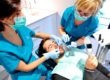



In today’s article we are going to talk about scaling and root planing, a term colloquially known as dental curettage. We will explain how to perform it correctly to treat gum disease, a pathology that affects more than 80% of the Spanish population and is the leading cause of tooth loss worldwide, according to data from the Spanish Society of Periodontology and Osseointegration (SEPA).
What causes gum disease?
Bacteria generated in the mouth and saliva mix and solidify, forming the so-called bacterial plaque, which can accumulate on the tooth surface or between the bone and gum supporting the teeth. Plaque on the tooth surface can lead to tooth decay and subsequent deterioration of the tooth. On the other hand, the one located between the gum and the bone will deteriorate them, a pathology known as gum disease. It will be necessary to act in time and in the correct way to stop the loss of dental support and thus avoid mobility and possible loss of teeth.
This disease has two stages: gingivitis and periodontitis. We speak of gingivitis when the affectation is in its early stages and has not yet generated bone loss. Symptoms are swelling, redness and bleeding of the gums. If not treated in time, it can lead to periodontitis, which in addition to the symptoms already mentioned, generates bone loss, receding gums, bad breath and tooth mobility in severe cases.
What is a dental curettage?
Curettage or scaling and root planing is a treatment that consists of removing the bacterial plaque that is located behind the gum and that deteriorates the bone that holds the teeth. Since the gingiva covers the bone, if the bone is lost, the gingiva recedes (falls). To perform the treatment correctly, a previous study, known as a periodontogram, must be carried out to measure the depth of bacteria on the 4 sides of each tooth. Thus, before performing the treatment, we will already know up to how many millimeters we will have to scrape to remove all the bacterial plaque.
Depending on the amount of bacteria detected in the study, the curettage will be divided between a total of 1 and 4 sessions. The treatment will be performed under local anesthesia and will use ultrasound and dental curettes, instruments that will be alternated depending on the type of plaque and the depth at which it is found.
In our dental clinic we have the technology Airflow Prophylaxis Mastera new dental technology which allows us to remove soft bacterial plaque through air and has an ultrasonic system that has less vibration and achieves more effective plaque removal by reducing sensitivity. We show it in the following photo.

When should a curettage treatment be performed?
In our dental clinic, the bacterial plaque that is located on the visible surface of the tooth and up to two millimeters below the gum, we remove it through dental hygiene. Curettage is performed to remove bacterial plaque between two and five millimeters deep.
To detect if there are bacteria below two millimeters, it will be essential to go to a clinic where the doctor or hygienist who sees you has specific training in gums and uses a periodontal probe to detect them. If so, the patient will be referred to the gum specialist to record the depth of the bacteria through the periodontogram, so that they can then be cleaned in a guided manner by performing the necessary curettage.

How many times does the curettage treatment have to be performed?
Once the curettage treatment has been performed, it will take 6 weeks for the gum to reattach to the tooth structure and regain its health. At this time is when we will update the periodontogram, to record if there is still any plaque remaining and thus be able to guide future maintenance. If the patient follows our indications of daily habits at home and attends the periodic maintenance (normally every 6 months), we will manage to keep the periodontal disease under control without having to perform more curettage treatments, thus slowing down bone loss.