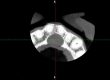



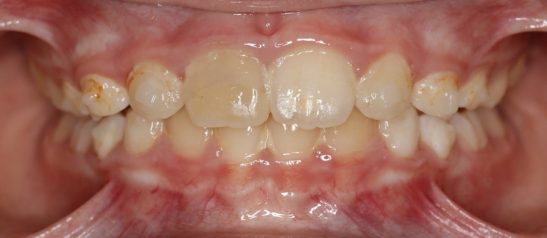
Childhood deep bite case being treated with the Invsialign First system.
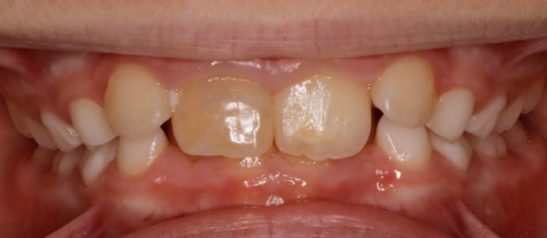
Childhood deep bite case being treated with the Invsialign First system.
In orthodontics, various aspects of the face, jaws and teeth are studied in order to ensure that the occlusal forces are distributed proportionally among all the teeth, that the meshing between them is correct and that they are aligned. In this way we avoid dental wear, overloading of the joint that joins the jaws, hygiene problems due to crowding and, in some cases, breathing difficulties. In addition, we will improve the esthetics of the smile.
In today’s article we will talk about the augmented overbite or deep bite. An overbite is a normal characteristic of the dentition if it is within certain parameters, but if it is increased (or decreased: open bite) it is considered pathological.
What is deep bite?
Ideally, when we close the mouth (occlude), the upper teeth should cover 2 to 4 millimeters of the lower teeth (25%). When this relationship is increased, a malocclusion problem called deep bite is considered to exist. In severe cases, the upper incisors can cover 100% of the lower incisors in a frontal view of the patient.
The following picture illustrates what is considered a correct overbite. This case was treated in our dental clinic with invisible aligners.

There are two types of overbite:
- Skeletal deep bite: It occurs when there is a lack of vertical growth in the back of the jaws. This causes the upper incisors to cover the lower incisors more than normal.
- Deep dental bite: occurs when dental malposition is the cause of the problem and the incisors are usually extruded (protruded or too erupted). This happens due to the lack of contact between the upper and lower incisors, which, not having a stop, protrude from the bone and the gum that holds them in place.
How to solve it? When?
The orthodontist will evaluate the case and solve it with orthodontic treatment in adults or orthopedic treatment in children. For adults with a very severe skeletal overbite, it may be necessary to combine orthodontic treatment with maxillofacial surgery, thus improving the harmony of the jaws and face. In our dental clinic we carry out studies and digital simulations prior to the treatment that we show to the patient so that he/she understands the whole procedure and sees the final result before starting.
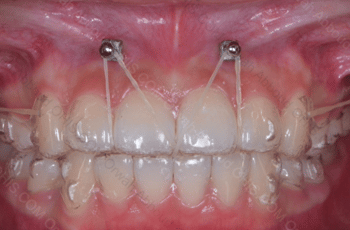
In cases of deep bite with extruded (protruding) teeth and gummy smile (when a lot of gum shows), teeth can be intruded (reinserted) to their correct height through orthodontics, and, in the most severe cases, with the help of micro-screws: anchor points that are placed in the gum during treatment. In these cases the gingiva will also be resituated in the correct position. This is illustrated in the following photo:
Overbite has a tendency to increase over time, so we recommend treating it as soon as possible. It is ideal to treat this pathology at the peak of jaw growth, which occurs between the ages of 11 and 16.
What happens if it is not treated?
Deep bite can be linked to other pathologies:
- Extrusion of the incisors: The lack of a stop in the occlusion causes the teeth to progressively protrude from the bone that holds them.
- Problems in the Temporomandibular Joint (TMJ), the joint that joins the jaws: The correct contact between the incisors guides the jaw in occlusion. In cases of deep bite, the guide is lost, generating malocclusion and progressive wear of the joint. In addition, the deep bite generates a lack of vertical support in the posterior teeth, causing incorrect bite points that overload the joint tissues. As the joint wears down, the treatment to resolve the pathology becomes more complex.
- In cases of deep bite in children, the upper incisors may block (alter) the correct growth of the jaw.
- Dental wear due to incorrect contact between them. Those that suffer the most are the incisors.
- Functional problems in chewing and vocalization in some cases.
- Problems in dental support (bone and gum): Malocclusion due to overbite generates trauma to bone and gum tissues.