



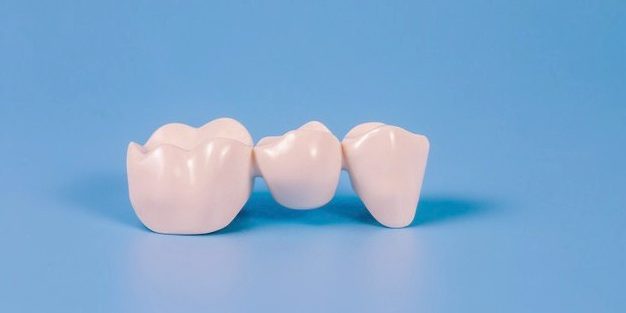
When do I need a fixed dental bridge?
Nowadays, we usually propose fixed dental bridges on implants to those patients who suffer several dental absences and who want to recover their function. Once the implants are placed, if good maintenance is followed, we will avoid the process of bone resorption (loss), since the bone already has a place to hold on to. In addition, we are able to restore the bite of our patients so that they can eat under normal conditions and the occlusal forces are distributed, maintaining oral functions in the long term.
In the absence of a tooth, we will recommend placing an implant much earlier than a bridge anchored to two healthy teeth, since we would have to prepare them for the placement of the bridge, weakening them and going against our principle of minimum invasion and dental conservation. When there are two adjacent missing teeth we will also recommend placing two implants so as not to make such a long bridge that could compromise the stability of the healthy teeth in the medium term.

Advantages of fixed dental bridges
Dental bridges are one of the most commonly used dental solutions for these factors:
- They allow patients to improve their appearance and facial harmony, since missing teeth cause bite problems and reduce the distance between the nose and chin, resulting in unsightly facial asymmetry.
- Dental bridges are more economical than dental implants, being widely used in cases of several dental absences.
- They are resistant and hold up well over time, as long as there are no more than two pieces between the two abutments, good maintenance is performed and a good occlusion study has been carried out beforehand.
- They are a fixed solution and more stable than prostheses. Although they are less stable than dental implants.
Disadvantages of fixed dental bridges
The main disadvantage of the fixed dental bridge anchored to two natural teeth is that in order to fit it it is necessary to grind the pieces that act as abutments, making it a more invasive treatment than dental implants. Our direction towards minimally invasive dentistry makes us think of other solutions such as dental veneers or dental inlays, treatments based on dental adhesion to the detriment of friction.
Types of dental bridge Which one do I need?
- Traditional dental bridge: Consists of one or more dental prostheses that are attached by means of dental crowns to the teeth adjacent to the lost tooth. This type of bridge is the most popular and can be placed as long as there are healthy natural teeth on both sides of the space left by the missing tooth. As we have already mentioned, for this type of cases we recommend placing a dental implant between healthy teeth.
- Cantilever dental bridge: Cantilever bridges are very similar to traditional bridges, but the dental prosthesis block is supported by a dental crown on a single tooth. We do not recommend this option.
- Maryland Dental Bridge: Maryland bridges are attached with a metal or porcelain framework bonded to the back of the two teeth adjacent to the missing tooth, without having to grind them. They are usually used as provisional prostheses to improve esthetics while waiting for the definitive implant prosthesis to be placed once the osseointegration time between the implant and the bone has elapsed.
- Fixed bridge on implants: Fixed bridges on implants are the ideal option when several teeth are missing. Instead of being attached to healthy teeth, they are screwed to dental implants. A specialist in dental rehabilitation and prosthodontics will study where to place the implants and the occlusion of both arches in order to restore function and esthetics to the patient.