



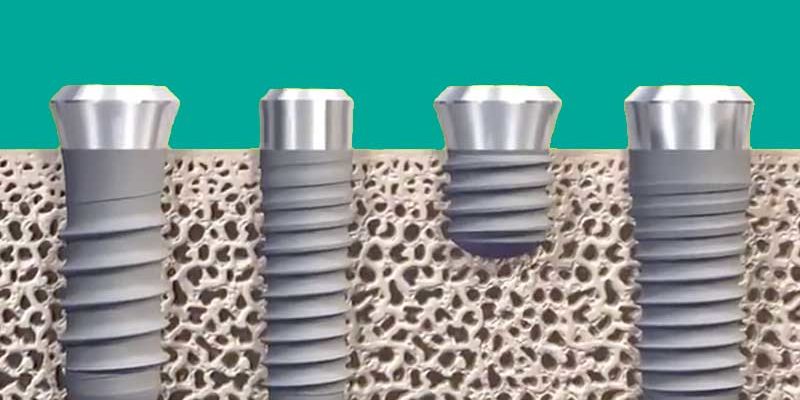
Dental implants are one of the treatments that integrate the most advanced dental technology. For this reason, in our
dental clinic in Barcelona
we take care to detail each of the phases of the placement process.
Dental implants can be manufactured in various materials. Most clinics use titanium implants, but we use Roxolid implants from Straumann, the most resistant and biocompatible implants, made of a titanium and zirconium alloy.
Our dentists in Barcelona only work with dental implants in Barcelona, with what is considered the best brand of dental implants in the world: Straumann.
What types of dental implants are there?
There are many types of dental implants, depending on the classification made, according to the type of placement, the materials or the technique used.
In this regard, the main types of dental implants that exist are:
- Endo-osseous implants (osseointegrated or inside the bone).
- Cylindrical vs. conical implants.
- Laminated implants (endosseous).
- Dental implants with different techniques: immediate loading, all on four, all on six, etc.
- Dental implants of nobel zirconium.
- Titanium alloy dental implants.
What is the implant placement process?
Dental implants require several phases for their placement. First of all, an examination of the bone support is carried out by means of a 3D X-ray and the procedure is planned.
In the case of our dental clinic in Barcelona, the planning is much more precise thanks to guided dental surgery. With our 3D technology we can pre-plan the case by computer and place the implant in the most optimal position.
Afterwards, a small operation is performed to place the implant in the bone support, in the previously planned position.
Finally, a provisional prosthesis is placed during the osseointegration process. In the case of our immediate load implants, the prosthesis is placed the same day of the intervention, screwed to the implant.
Osseointegration
The next step after implant placement is the osseointegration process. During this stage, the implant bonds with the bone, forming a tissue that will no longer separate.
This process depends on the individual, but usually takes about three months. After this time, the implant is considered to be fully integrated and functional.
It is then when the definitive prosthesis is designed and placed, which will be fixed on the dental implant.
My dental implant screw is showing. What should I do?
The screw connection between the dental implant and the prosthesis is very common and the most reliable. To do this, the upper part of the prosthesis must be drilled through which the screw will be inserted. Next, we will fill the chimney (or hole) with composite: a resistant and aesthetic material.
There are cases in which the composite can jump, since it is not as strong as the ceramic of the prosthesis and it is right at the base of the dental occlusion.
In case this problem with the dental implant occurs, it would be advisable to go to our dental clinic in Barcelona, where our specialists in dental aesthetics, to avoid the accumulation of food, will fill the gap with the composite that best suits your case.
Screwless dental implants
Screwless dental implants do exist. This type of prosthesis uses a different grip than the traditional one. Thus, the prosthesis is not screwed to the metal support, but is anchored by means of a different system.
This means that, when maintenance is required, they must be broken. That is why the most commonly used implants for their comfort are those that are attached to the support in a fixed manner, thus ensuring that they do not move.
In any case, before performing any type of implant, we will proceed to perform an initial examination and x-ray, in order to recommend the one that best suits you.
What is the function of each of the components of a dental implant?
Dental implants are made up of three main components:
- The body: is the titanium and zirconium alloy that is inserted into the bone tissue.
- The abutment or attachment: it is the part that connects the body to the crown, it can be male or female.
- The crown: it is the visible part of the implant and the part that replaces the tooth.
All these parts are used so that the implant remains on the bone tissue without discomfort, in order to recover the esthetic and chewing function of a lost tooth.
As you can see, implants have many advantages and are very functional and, in short, they are the best substitutes after tooth loss.


